

This guide is a single, current briefing on the artificial intelligence news today that matters for people who actually use these tools. We cover the model race, the rise of AI agents, the money and IPO wave, the chatbot market, AI video, regulation, security, and the trends worth watching for the rest of the year. Every number here is sourced and dated, so you can act on it with confidence.
Vhiz AI tracks more than 100 AI tools across 14 working categories, from AI chatbots to AI code tools, which is the lens we bring to this roundup: not just what was announced, but what it changes for founders, marketers, developers, students, and creators trying to choose the right software.
What this guide covers
- What Counts as the Latest AI News in 2026?
- Why This Moment Matters for Businesses and Creators
- The Frontier Model Race: Opus 4.8, GPT-5.5, Gemini and Grok
- Open-Weight and Chinese Models Closed the Gap
- The Year of AI Agents: From Chatbots to Autonomous Work
- AI Money: The $3.8 Trillion IPO Wave and Record Funding
- The Chatbot Race and the New Consumer AI
- AI Video and Creative Tools After the Sora Shutdown
- AI Regulation News 2026: EU AI Act, Colorado and Export Controls
- AI Security and Jobs: Agentjacking, Layoffs and New Roles
- Latest AI Trends 2026: What to Watch Next
- How to Keep Up and Put AI to Work
What Counts as the Latest AI News in 2026?
The latest AI news 2026 is no longer one story about a single chatbot. It is a stack of connected developments: new frontier models, the spread of autonomous AI agents, a wave of open source releases, record funding rounds, and the first real enforcement deadlines for AI regulation. The center of gravity has moved from flashy demonstrations to systems that do real work inside companies.
Three shifts define the current artificial intelligence news cycle. First, capability gaps between the top models have narrowed to within a few points on most benchmarks, so the question is no longer which model is best but which model is best for a specific job. Second, intelligence is getting cheaper fast, with Chinese labs in particular collapsing the cost of strong performance. Third, the action has shifted from the chat box to the agent, meaning AI that plans, uses tools, and finishes multi step tasks with limited supervision.
Key takeaway. There is no single winner in 2026. The smart move is to match each task to the right tool, and to revisit that choice often, because the leaderboard genuinely changes every few weeks.
Why This Moment Matters for Businesses and Creators
Getting this wrong is expensive in two directions. Move too slowly and competitors who wire AI into their core workflows pull ahead on speed and cost. Move carelessly and you ship unreliable automation, leak data, or build on a tool that is discontinued months later. Both failure modes are visible in the current ai industry news.
The opportunity is just as concrete. Enterprises report a median payback of about 5.1 months on AI agent deployments, with sales development agents recouping cost in roughly 3.4 months, according to 2026 BCG and Forrester surveys compiled by industry analysts. Yet only about 29 percent of organizations say they see significant return from generative AI, and just 23 percent from agents, per WRITER’s 2026 enterprise survey of 1,200 executives and 1,200 employees. The gap between the winners and everyone else comes down to tool choice, governance, and workflow design, not raw enthusiasm.
Reality check. Gartner expects more than 40 percent of agentic AI projects to be canceled by 2027 due to unclear value or weak controls. The organizations that succeed start with scoped, lower risk use cases and add monitoring before they scale.
The Frontier Model Race: Opus 4.8, GPT-5.5, Gemini and Grok
The headline of the latest artificial intelligence news is the speed of the frontier model race. As of June 2026, Anthropic’s Claude Opus 4.8 leads the Artificial Analysis Intelligence Index with a blended score of 61.4, narrowly ahead of OpenAI’s GPT-5.5 at 60.2, Google’s Gemini 3.1 Pro at 57, and xAI’s Grok 4.3 at 53. Opus 4.8 dethroned GPT-5.5 only weeks after GPT-5.5 itself took the top spot, which captures how quickly the lead now changes.
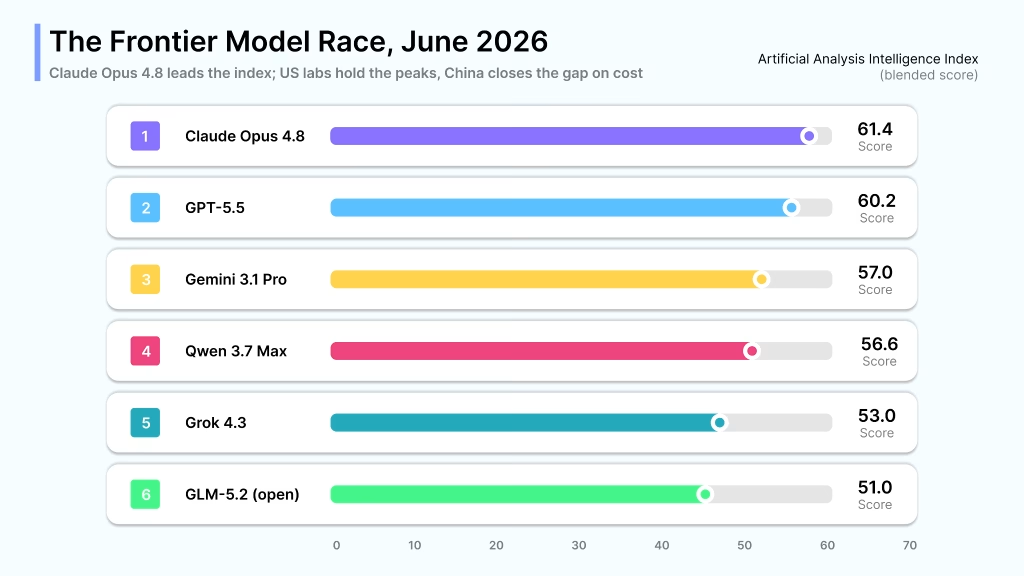
Figure 1: The frontier model race in June 2026. The top models sit within a few points of one another.
Where each model wins
The differences that matter are categorical, not hierarchical. Claude Opus 4.8 leads on coding, posting 88.6 percent on SWE-bench Verified and 69.2 percent on the harder SWE-bench Pro, and it pairs well with autonomous coding agents. GPT-5.5, OpenAI’s first fully retrained base architecture since GPT-4.5, is strong on agentic terminal work and leads on creative writing. Gemini 3.1 Pro leads on pure reasoning and data analysis and remains the value pick of the closed frontier. Grok 4.3 is the cheapest of the four with solid tool use.
| Model | Lab | Best at | Index | List price (in / out per 1M) |
| Claude Opus 4.8 | Anthropic | Coding, agentic work, low hallucination | 61.4 | $5 / $25 |
| GPT-5.5 | OpenAI | Creative writing, terminal and tool use | 60.2 | $5 / $30 |
| Gemini 3.1 Pro | Google DeepMind | Reasoning, data analysis, value | 57.0 | from ~$2 / $12 |
| Grok 4.3 | xAI | Budget agentic tasks | 53.0 | lowest of the four |
Table 1: Frontier model snapshot, June 2026. Index = Artificial Analysis Intelligence Index. Prices are list API rates.
Above the publicly available tier, Anthropic introduced Claude Fable 5 and Claude Mythos 5 on June 9, a capability step beyond Opus 4.8. Days later, on June 12, a United States export control directive restricted access to these models by foreign nationals, an early sign that the most capable systems are now treated as strategically sensitive. For a deeper, use case by use case breakdown, see our guide to ChatGPT vs Claude vs Gemini and browse the full AI chatbot tools directory. Independent benchmarks for every model are tracked by Artificial Analysis, and OpenAI documents its current flagship in the GPT-5.5 release notes.
Open-Weight and Chinese Models Closed the Gap
One of the most important threads in recent AI news is the rise of open weight and Chinese models. In June 2026 the open weight GLM-5.2 from Z.ai beat GPT-5.5 on SWE-bench Pro, scoring 62.1 to 58.6 on that specific coding benchmark. Earlier, GLM-5.1 became the first open weight model ever to top SWE-bench Pro, holding the lead for nine days before a new Claude release reclaimed it.
The cost story is even sharper. Alibaba’s Qwen 3.7 Max scores 56.6 on the intelligence index at about $3.75 per million tokens, roughly 65 percent cheaper than the premium closed models. Shanghai based MiniMax 3 reached a competitive ranking while pricing input tokens at about $0.53 per million, and its native audio architecture made it a favorite for low latency voice agents. DeepSeek V4-Pro, released under an MIT license, posted a perfect score on the Putnam 2025 mathematics set.
What it means. Analysts now describe the United States and China AI capability gap as effectively closed for many tasks. The US holds the peak on the hardest reasoning, while China is commoditizing strong performance at a fraction of the price. For most teams, that means cheaper access to near frontier intelligence.
The Year of AI Agents: From Chatbots to Autonomous Work
If one phrase defines the 2026 AI industry news, it is AI agents. Agentic AI describes systems that do not just answer questions but plan, call tools, and complete multi step tasks with limited human input. In 2026 this shifted from pilot projects to production deployments across coding, support, research, finance, and commerce.
How fast adoption is moving
The adoption numbers are striking. Gartner reports that 80 percent of enterprise applications shipped or updated in the first quarter of 2026 embedded at least one AI agent, up from 33 percent in 2024, and forecasts that 40 percent of all enterprise apps will include task specific agents by the end of the year, up from under 5 percent in 2025. Production reality is more concentrated: about 31 percent of organizations have an agent actually running in production, led by banking and insurance at 47 percent, with healthcare and government still in the teens.
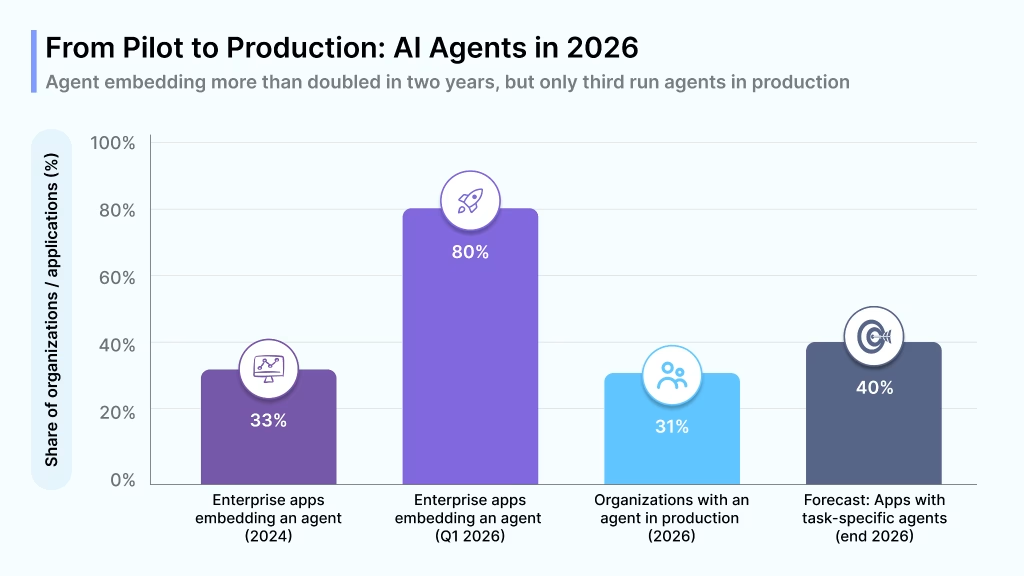
Figure 2: AI agents crossed from pilot to production in 2026, but full production use is still concentrated.
Adoption at the human level is near universal. In WRITER’s 2026 survey, 97 percent of executives said their company deployed AI agents in the past year and 52 percent of employees were already using them. The connective tissue making this possible is the Model Context Protocol, the open standard for connecting agents to data and tools, which has crossed more than 9,400 public servers. Multi agent setups are emerging too, with about 22 percent of production deployments now coordinating three or more agents.
Claude Code
Anthropic’s agentic coding tool reads your codebase, runs commands, and commits to git from the terminal, VS Code, or the web. It is a leading example of an agent doing sustained, real engineering work, not just autocomplete.
Pro tip. Governance is the difference between agents that scale and agents that get canceled. Only about 1 in 5 organizations has a mature model for agent governance. Start with audit trails, human in the loop checkpoints, and a clear owner before you expand. Explore options in our AI business tools and AI code tools categories.
Pro tip. Governance is the difference between agents that scale and agents that get canceled. Only about 1 in 5 organizations has a mature model for agent governance. Start with audit trails, human in the loop checkpoints, and a clear owner before you expand. Explore options in our AI business tools and AI code tools categories.
AI Money: The $3.8 Trillion IPO Wave and Record Funding
The ai breaking news of late spring was financial. In May 2026 Anthropic raised $65 billion in a Series H round at a $965 billion valuation, overtaking OpenAI to become the world’s most valuable AI startup. That is a remarkable climb from a $380 billion valuation in February. Anthropic’s run rate revenue crossed $47 billion, up from roughly $10 billion a year earlier, driven heavily by its coding products.
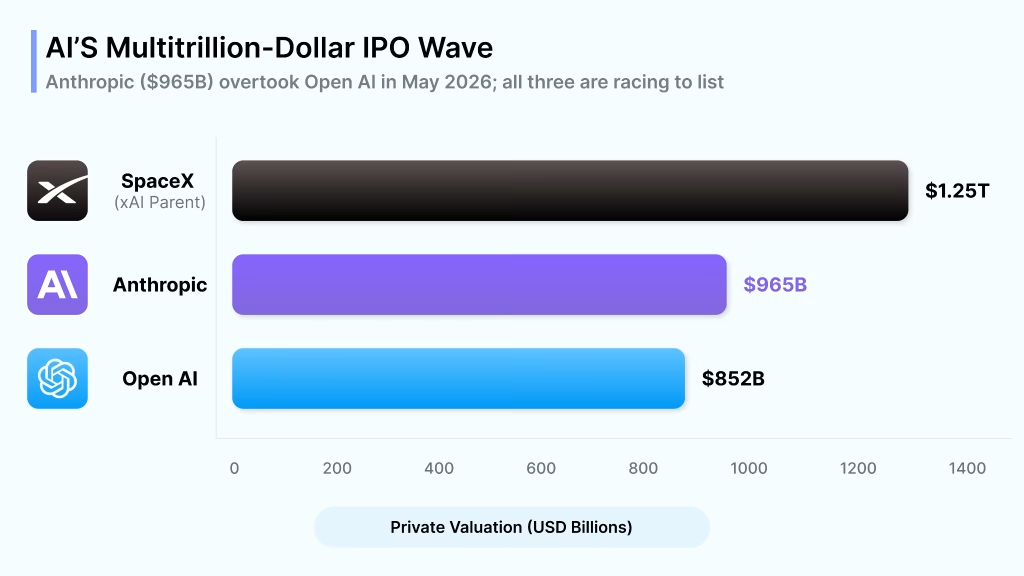
Figure 3: The valuations heading into AI’s IPO wave. Anthropic overtook OpenAI in May 2026.
The bigger picture is an IPO wave. Anthropic filed confidentially for a public listing on June 1, OpenAI followed with its own filing in June, and SpaceX, the parent of xAI, is valued above $1.25 trillion and also heading public. Together these listings could approach $3.8 trillion in combined market value. AI captured roughly $72 billion of venture funding in May 2026 alone, about 79 percent of all venture capital that month, with coding startup Cognition raising $1 billion and customer service firm Sierra raising $950 million. You can read the funding details in Anthropic’s own Series H announcement.
The hardware and infrastructure race
On the hardware side, OpenAI unveiled its first custom chip through a Broadcom partnership in a bid to reduce reliance on Nvidia, while Nvidia and SK hynix deepened a memory partnership tied to next generation AI supercomputers. Hyperscaler capital spending on AI infrastructure now exceeds $725 billion per year, which is the physical foundation under all of these valuations.
The Chatbot Race and the New Consumer AI
For everyday users, the ai news today is that the chatbot race tightened sharply. ChatGPT still leads global AI chatbot web visits at about 54.7 percent in June 2026, but that is down from 76.5 percent in February 2025. Google Gemini climbed to 27.4 percent, and Claude reached 8.2 percent while growing faster than either rival in percentage terms, according to the Momentic report based on Similarweb data.
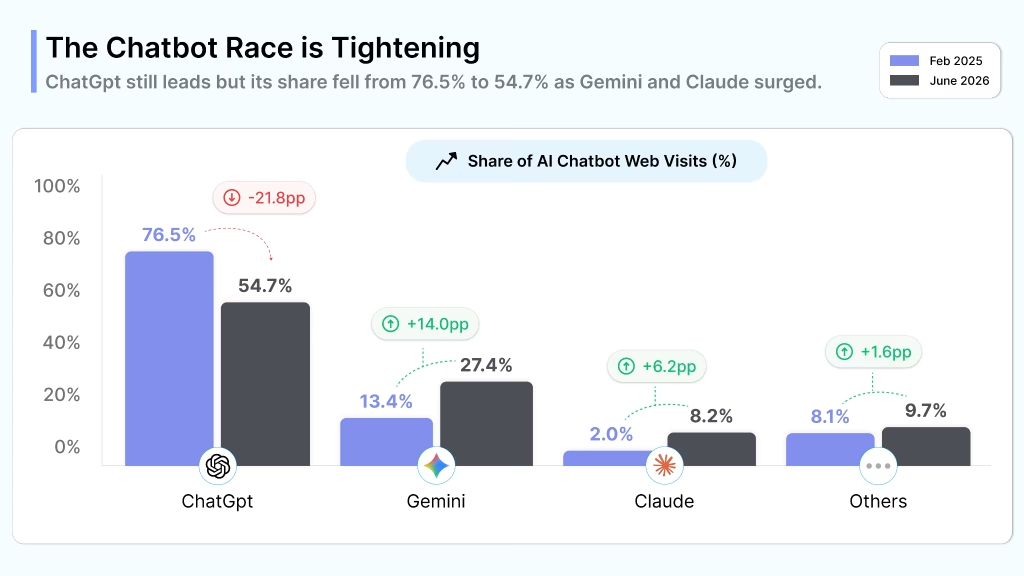
Figure 4: ChatGPT still leads, but Gemini and Claude have taken meaningful share since early 2025.
Two consumer moves stood out. At its 2026 developer conference, Apple shipped a rebuilt Siri that blends its own on device models with Google Gemini in the cloud, and it added Claude as an option on the iPhone. Because Apple reaches billions of users, this could pull millions of people into AI assistants for the first time. In a notable talent move, Noam Shazeer, a co author of the foundational Transformer paper, left Google to join OpenAI as lead for architecture research on June 18.
For most people the practical question is which assistant to use for which job. Our ChatGPT vs Claude vs Gemini comparison breaks that down by writing, coding, reasoning, and price, and the AI chatbot tools category lets you compare options side by side.
AI Video and Creative Tools After the Sora Shutdown
Creative AI saw one of the most surprising stories of the year. OpenAI discontinued its Sora video app on April 26, 2026, with the API scheduled to sunset on September 24, ending the Sora consumer brand even as the underlying model remained available through partners. That left the field open, and several rivals stepped up.
Google’s Veo 3.1 emerged as the technical leader, generating native 4K video with synchronized audio in a single pass, including dialogue, sound effects, and ambient sound. Kuaishou’s Kling 3.0 pushed longer clips and low prices, ByteDance’s Seedance 2.0 solved character consistency with an identity lock feature, and Runway Gen-4.5 remained a favorite for image to video. Across the board, native audio and 4K output went from differentiators to baseline expectations in under a year.
Midjourney
Still one of the most artistically capable AI image generators, Midjourney turns text prompts into polished, stylized artwork. It is a strong starting point for thumbnails, concept art, and brand visuals.
If you produce visual content, this is a moment to keep free accounts on several tools and route each clip to whichever model fits. Explore current options in our AI video tools and AI image tools categories, and for design specific picks see Canva vs Adobe Firefly and the Midjourney V7 review.
AI Regulation News 2026: EU AI Act, Colorado and Export Controls
The ai regulation news today is that rules are moving from drafts to deadlines. In the United States, the Colorado Consumer Protections for Artificial Intelligence Act takes effect on June 30, 2026, covering high risk AI systems used in employment, healthcare, finance, education, housing, and legal services. It requires risk management programs, annual impact assessments, disclosure when AI drives consequential decisions, and an appeal right for affected residents.
Federal and international rules to watch
At the federal level, a 269 page bill known as the Great American AI Act was introduced in June and proposes to pause state AI laws for three years, which would complicate the Colorado timeline if it passes. It has not passed, so the June 30 deadline still stands. Internationally, the European Union AI Act continues to phase in obligations for general purpose and high risk systems through 2026, and new United States export controls now restrict access to the most capable frontier models.
Compliance note. If your business uses AI for hiring, lending, healthcare, or other consequential decisions, treat 2026 as the year compliance becomes real. Map where AI touches those decisions, document it, and keep a human review step. This is general information, not legal advice, so confirm specifics with a qualified professional. See current authoritative summaries at the EU AI Act resource.
AI Security and Jobs: Agentjacking, Layoffs and New Roles
As agents spread, so does their attack surface. Security researchers documented a new class of attack called agentjacking, in which malicious instructions are hidden in data that an AI coding agent reads, such as error tracking output, then executed by the agent. Early reports cited an 85 percent exploitation rate across more than 2,300 affected organizations. Gartner projects that by 2028, a quarter of enterprise breaches will trace back to AI agent abuse. The practical defense is simple: treat tool output as untrusted and add a human review step before an agent acts on it.
The jobs picture is mixed and very real. Meta began cutting about 8,000 roles, roughly 10 percent of its workforce, as part of an AI focused restructuring, contributing to more than 100,000 tech job cuts recorded in 2026, many attributed to automation. At the same time, the World Economic Forum projects 170 million new jobs by 2030 against 92 million displaced, a net gain of 78 million, and new titles such as AI agent owner, agentic ops lead, and chief AI officer are appearing across industries.
For students and job seekers. The roles growing fastest involve directing and governing AI rather than competing with it. Learning to brief, evaluate, and supervise AI agents is quickly becoming a core professional skill across marketing, development, finance, and operations.
Latest AI Trends 2026: What to Watch Next
Pulling the threads together, here are the ai technology trends 2026 most likely to shape the rest of the year. These are the patterns we watch as we add and update tools in the Vhiz AI directory.
- Model routing over model loyalty. The strongest teams stop picking one model and build systems that send each task to the best tool for cost, speed, and capability.
- Agents everywhere, governance first. Expect agents to expand beyond engineering into research, finance, and customer experience, with the winners investing in oversight before scale.
- Cheaper intelligence. Open weight and Chinese models keep driving the price of strong performance down, which is good news for small teams and solo creators.
- Regulation with teeth. 2026 brings the first real enforcement deadlines, so documentation and human oversight move from nice to have to required.
- Native multimodal as default. 4K video with synchronized audio, voice agents, and image understanding are now baseline features rather than premium extras.
How to Keep Up and Put AI to Work
The honest takeaway from the latest AI news 2026 is that keeping up is now a process, not a one time decision. The leaderboard shifts every few weeks, prices fall, and new tools launch daily. The practical answer is to lean on a curated directory, try a small set of tools against your real workflow, and re evaluate often. Here are strong starting points across the categories that matter most, beginning with branding.
Zoviz
A complete AI branding suite for logos, brand kits, and marketing ready assets. Used by more than 1.3 million people, Zoviz is the fast way to get a professional brand identity, ideal for founders and small teams launching something new.
Claude Code
The leading agentic coding tool for developers who want an AI that reads the whole codebase and ships real changes, not just snippets.
Jasper
An AI writing assistant built for marketing teams, useful for turning the trends above into campaigns, landing pages, and content at scale.
From there, explore the full Vhiz AI tools directory or jump straight to a category: AI writing tools, AI marketing tools, AI branding tools, or AI code tools. For ready made playbooks, our guides to the best AI marketing tools and best AI logo generators turn this news into action.
Frequently Asked Questions
What is the latest AI news in 2026?
The latest AI news in 2026 centers on five themes: a fast moving frontier model race led by Claude Opus 4.8, GPT-5.5 and Gemini 3.1 Pro; the rapid spread of AI agents into production; record funding and an IPO wave from Anthropic, OpenAI and SpaceX; the first real AI regulation deadlines; and a wave of cheaper open weight models. The pace is unusually fast, with new flagship models shipping roughly every six weeks.
What is the best AI model in 2026?
There is no single best AI model in 2026. As of June, Claude Opus 4.8 leads the Artificial Analysis Intelligence Index at 61.4 and tops coding benchmarks, GPT-5.5 leads creative writing and terminal work, Gemini 3.1 Pro leads reasoning and offers strong value, and Grok 4.3 is the budget pick. The right choice depends on your task, so match the model to the job and compare options in the Vhiz AI chatbot tools directory.
What are the top AI trends in 2026?
The top AI trends in 2026 are model routing instead of model loyalty, the spread of agentic AI into research and finance, falling prices driven by open weight and Chinese models, real regulatory enforcement, and native multimodal features such as 4K video with synchronized audio becoming standard. The common thread is that AI has moved from impressive demos to dependable infrastructure that does measurable work inside organizations.
What is agentic AI and why does it matter in 2026?
Agentic AI refers to systems that plan, use tools, and complete multi step tasks with limited supervision, rather than only answering single questions. It matters because adoption exploded in 2026: Gartner found 80 percent of enterprise apps updated in early 2026 embedded at least one agent. Median payback is about five months, but only around a third of organizations run agents in production, and governance is the main barrier to scaling safely.
Is there major AI regulation news today?
Yes. In the United States, the Colorado Consumer Protections for Artificial Intelligence Act takes effect on June 30, 2026, regulating high risk AI in areas like hiring and lending. A federal bill proposes pausing state AI laws for three years but has not passed. The European Union AI Act continues phasing in obligations through 2026, and new export controls now restrict access to the most capable frontier models.
Which AI companies are going public in 2026?
2026 is shaping up as a historic year for AI listings. Anthropic filed confidentially for an IPO on June 1 at a $965 billion valuation, OpenAI filed its own paperwork in June at roughly an $852 billion valuation, and SpaceX, the parent of xAI, is valued above $1.25 trillion and heading public. Combined, these listings could approach $3.8 trillion in market value, among the largest debuts in history.
What happened to Sora and what are the best AI video tools in 2026?
OpenAI discontinued the Sora video app on April 26, 2026, with its API set to sunset on September 24. The strongest alternatives are Google Veo 3.1, which generates native 4K video with synchronized audio, Kling 3.0 for longer and cheaper clips, Seedance 2.0 for character consistency, and Runway Gen-4.5 for image to video. Native audio and 4K are now baseline features. Compare current options in the Vhiz AI video tools category.
How can I keep up with the latest AI news and tools?
Because the leaderboard changes every few weeks, the best approach is to follow a curated directory, test a small set of tools against your real workflow, and re evaluate often. Vhiz AI tracks more than 100 AI tools across 14 categories with comparisons and guides, so you can move from headlines to the right software quickly. Bookmark the blog and explore tools by category to stay current without the noise.